

This is where we land every Saturday: one open letter, written to one person in one specific moment. If someone came to mind as you read this one, send it to them.
Dear friend,
I am not sure when it happened. Perhaps it was after a long illness, or after a prayer that seemed to go unanswered. Perhaps it was a slow drift, with one skipped evening and then another, until the habit that once held your days quietly fell away. You may still go to church, and you may still say the words when others are watching. But when you are alone, you do not pray. Somewhere along the way, you stopped.
Maybe you have not told anyone. It can feel like a private failure, the kind that a person with real faith would not suffer. So you carry it quietly, and the quiet makes it heavier.
I want to say something first, and I mean it. You are not too far gone, and God is not standing at a distance with folded arms.
What Silence Can Mean
When prayer stops, there is rarely one reason. Sometimes it is exhaustion. A person whose days are full of caring for others may have nothing left at night, even for a sentence. Sometimes it is disappointment. We asked for something with all our hearts, and it did not come, and every prayer afterward felt like knocking on a door that had been bolted.
Sometimes it is simply emptiness. The words feel dry, as though we are speaking into a room with no one in it. And sometimes, though we do not like to admit it, it is a quiet anger that we have not known how to voice.
None of these makes you faithless. The Bible is full of people who reached these places, and it does not hide them.
You Are in Good Company
There is a psalm, written by a man named Heman, that ends in darkness. Most psalms of lament turn toward hope by the last verse. This one does not.
1 Lord, you are the God who saves me;
day and night I cry out to you.
2 May my prayer come before you;
turn your ear to my cry.3 I am overwhelmed with troubles
and my life draws near to death.
4 I am counted among those who go down to the pit;
I am like one without strength.
5 I am set apart with the dead,
like the slain who lie in the grave,
whom you remember no more,
who are cut off from your care.6 You have put me in the lowest pit,
in the darkest depths.
7 Your wrath lies heavily on me;
you have overwhelmed me with all your waves.
8 You have taken from me my closest friends
and have made me repulsive to them.
I am confined and cannot escape;
9 my eyes are dim with grief.I call to you, Lord, every day;
I spread out my hands to you.
10 Do you show your wonders to the dead?
Do their spirits rise up and praise you?
11 Is your love declared in the grave,
your faithfulness in Destruction?
12 Are your wonders known in the place of darkness,
or your righteous deeds in the land of oblivion?13 But I cry to you for help, Lord;
in the morning my prayer comes before you.
14 Why, Lord, do you reject me
and hide your face from me?15 From my youth I have suffered and been close to death;
Psalm 88 New International Version
I have borne your terrors and am in despair.
16 Your wrath has swept over me;
your terrors have destroyed me.
17 All day long they surround me like a flood;
they have completely engulfed me.
18 You have taken from me friend and neighbor—
darkness is my closest friend.
It closes with the writer saying that darkness is his closest friend. Yet it was preserved in the Scriptures and handed down to be read in worship. The people who gathered it did not think that an unfinished prayer was a failed one.
David, who wrote so many psalms, also knew what it was like to feel abandoned. How long, Lord, he asked, will you forget me forever?
1 How long, Lord? Will you forget me forever?
Psalm 13:1-2 New International Version
How long will you hide your face from me?
2 How long must I wrestle with my thoughts
and day after day have sorrow in my heart?
How long will my enemy triumph over me?
That is not the speech of a man who always felt close to God. It is the speech of someone who stayed in the conversation even when God felt far away, and who said so honestly.
And there is Jesus Himself. In the garden, the night before He died, He told His friends that His soul was overwhelmed with sorrow to the point of death. – Matthew 26:38. On the cross, He cried out, my God, my God, why have you forsaken me? – Mark 15:34. If prayer in the dark was something Jesus knew, then it cannot be a sign of weak faith.
When You Do Not Have the Words
Apostle Paul wrote to the Romans something that has comforted me in my own dry seasons. We do not know what we ought to pray for, he said, but the Spirit himself intercedes for us through wordless groans. – Romans 8:26. Notice what that means. Even when we have nothing to say, someone is speaking on our behalf. Your silence is not the end of the prayer. It may be the place where the Spirit has taken over.
I find this a great relief. We tend to treat prayer as a performance that requires fluency and feeling, and when we cannot manage it, we conclude that we have failed. But apostle Paul says that the work is not entirely ours. Our part is simply to remain turned toward God, even when we cannot say a word.
Then there is the father who came to Jesus with a sick child, and who cried out, I do believe, help me overcome my unbelief. – Mark 9:24. It was not a polished prayer. It was half faith and half doubt, and Jesus answered it. You do not need to resolve your doubts before you speak. You may bring them along.
A Very Small Way Back
I do not want to hand you a program. If you have been away from prayer for a long time, a large plan will probably collapse by Thursday, and that will only add to the guilt. So let me offer something very small.
Choose one sentence. Not a paragraph, and not a request. Something like, Lord, I am here. Or, I do not know what to say, but I am not leaving. Say it once a day, at the same time, in the same place. The kitchen counter will do, or the edge of the bed.
Say it even if it feels hollow. Do not wait to feel something. A sentence spoken without feeling is still a sentence spoken to God, and he has always been able to hear the voice beneath the words.
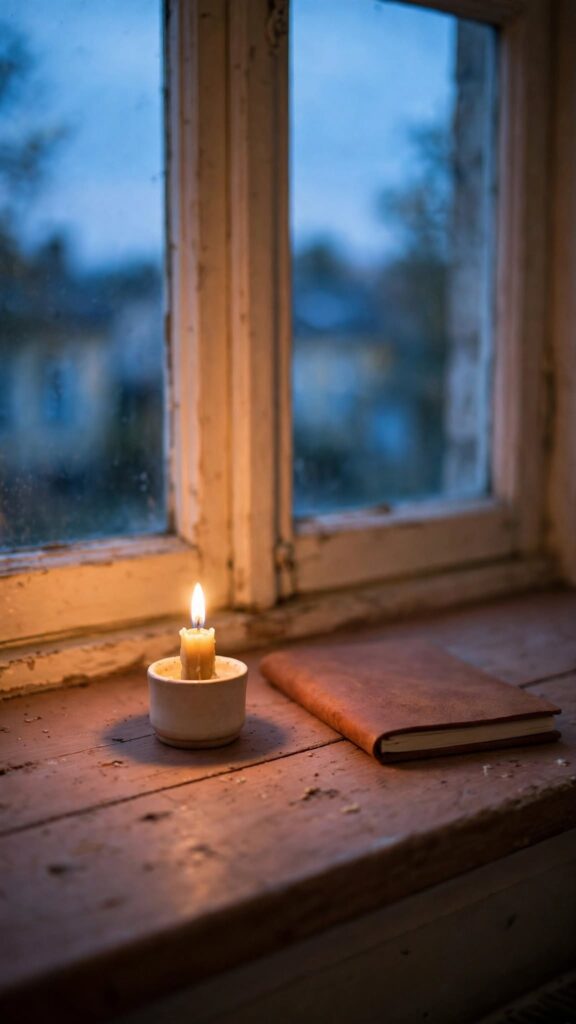
If a longer prayer comes, let it. If not, the sentence is enough for now. A flame that has almost gone out is not relit with a bonfire. It is relit with a small, steady breath.
Do Not Do This Alone
You will find it easier if someone dear to you knows. Choose a friend you trust and tell them that you have stopped praying and would like to begin again. Ask whether they would pray for you, or sit with you for a few minutes while you say your sentence. Prayer was never meant to be a solitary struggle.
I also want to say a gentle word about your health. Sometimes a long silence before God comes alongside something else, such as deep tiredness or a low mood that will not lift. If that sounds like you, please speak to a doctor or a counselor as well. Seeking help for the body and mind is not a lack of faith. It is one of the ways we take care of what God has given us.
Read Also: Stewarding Your Energy, Not Just Your Time
Read Also: An-open-letter (series tag)
Read Also: Worldview-clash (series tag)
A Closing Word
Maybe you are reading this with a sense of relief, because someone has finally named what you have been carrying. Or maybe you are only skimming it, unsure whether it is for you. Either way, I want you to know that no one here is keeping score.
The God of the Bible does not wait for his people to get their prayers in order before he draws near. He has always come toward those who were lost, whether they were running or simply too weary to walk. If you cannot find your way back tonight, he knows where you are.
With love, Ordered by Grace
Did someone come to mind as you read this? Send it to them. And if there is a feeling or a season you would like an open letter written to, tell us in the comments or through the contact page.