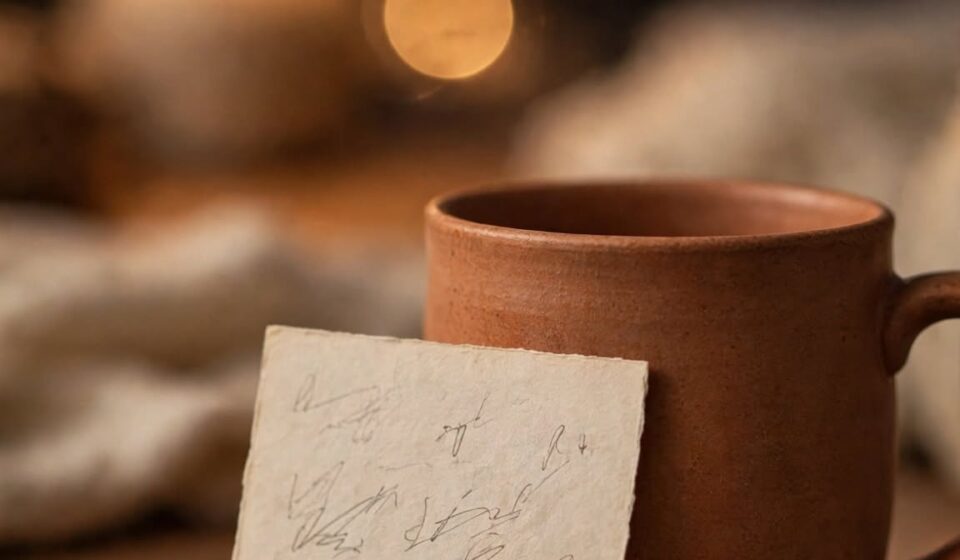

Monday again. This is where we land every Monday, with one small rhythm to try this week, small enough to fit into a full life and useful enough to be worth the two minutes it costs.
This Week’s Rhythm
Each night this week, before you go to bed, take a scrap of paper or a notecard and write one line about tomorrow. Only one. It should name the single thing that would make tomorrow a good day if it were done, even if everything else slipped. Then set the card where you will see it first, on the kitchen counter or under your phone.
That is the whole practice. You do not need a planner or an app. You need a pen and a small piece of paper, along with the willingness to choose one thing instead of carrying a whole list around in your head.
If you already use a planner, write the line there. Just make sure it stands alone, apart from the rest of the page, so that you can find it with a glance.
Why This One Matters
Most of us fall asleep with tomorrow still running in the background. The email we forgot to send and the conversation we are dreading keep circling, and neither one gets settled. The mind treats an unfinished list as an alarm that never switches off, so we lie there rehearsing it.
Writing it down changes that. Once a task is on paper, your mind no longer has to guard it, and a guarded thing can sometime feel like a tiring thing. So choosing one line out of the pile does something further. It tells you what matters most before the day has a chance to decide for you.
Think about how the Israelites received their food in the wilderness. God gave them manna each morning, enough for that day.
13 That evening quail came and covered the camp, and in the morning there was a layer of dew around the camp. 14 When the dew was gone, thin flakes like frost on the ground appeared on the desert floor. 15 When the Israelites saw it, they said to each other, “What is it?” For they did not know what it was.
Moses said to them, “It is the bread the Lord has given you to eat. 16 This is what the Lord has commanded: ‘Everyone is to gather as much as they need. Take an omer for each person you have in your tent.’”
17 The Israelites did as they were told; some gathered much, some little. 18 And when they measured it by the omer, the one who gathered much did not have too much, and the one who gathered little did not have too little. Everyone had gathered just as much as they needed.
19 Then Moses said to them, “No one is to keep any of it until morning.”
20 However, some of them paid no attention to Moses; they kept part of it until morning, but it was full of maggots and began to smell. So Moses was angry with them.
21 Each morning everyone gathered as much as they needed, and when the sun grew hot, it melted away.
Exodus 16:13-21 New International Version
He told them to gather only what they needed. Those who tried to store up extra found it spoiled by morning. The lesson was not only about bread. It was about learning to live one day at a time, trusting that tomorrow would be provided for when it arrived.
Jesus said something close to this when he told his listeners not to worry about tomorrow, because tomorrow would have its own worries. He was not telling them to ignore the future. He was telling them that the future is not theirs to carry tonight.
Do Not Worry
25 “Therefore I tell you, do not worry about your life, what you will eat or drink; or about your body, what you will wear. Is not life more than food, and the body more than clothes? 26 Look at the birds of the air; they do not sow or reap or store away in barns, and yet your heavenly Father feeds them. Are you not much more valuable than they? 27 Can any one of you by worrying add a single hour to your life[a]?
28 “And why do you worry about clothes? See how the flowers of the field grow. They do not labor or spin. 29 Yet I tell you that not even Solomon in all his splendor was dressed like one of these. 30 If that is how God clothes the grass of the field, which is here today and tomorrow is thrown into the fire, will he not much more clothe you—you of little faith? 31 So do not worry, saying, ‘What shall we eat?’ or ‘What shall we drink?’ or ‘What shall we wear?’ 32 For the pagans run after all these things, and your heavenly Father knows that you need them. 33 But seek first his kingdom and his righteousness, and all these things will be given to you as well. 34 Therefore do not worry about tomorrow, for tomorrow will worry about itself. Each day has enough trouble of its own.
Matthew 6:25-34 New International Version
A single line on a card is a small way of agreeing with Him. You name what you will do, and you leave the rest alone.

Moses wrote in one of the psalms that we should ask God to teach us to number our days so that we gain a wise heart.
12 Teach us to number our days,
Psalm 90:12 New International Version
that we may gain a heart of wisdom.
That is a prayer about counting what is in front of us instead of what is far off. One honest line for tomorrow is a very modest version of the same request.
How to Actually Try This Rhythm
Pick a time that already happens every night, such as brushing your teeth or plugging in your phone, and attach the card to it. Habits stick better when they ride on something that is already there.
When you sit down, ask yourself one question. If only one thing gets done tomorrow, what should it be? Do not answer with the thing that feels most urgent. Urgent things have a way of announcing themselves. Look instead for the thing that would quietly matter, such as the phone call to a friend who is struggling, or the one chapter of a project you keep putting off.
Write it in plain words, short enough to read at a glance. Not “deal with finances” but “pay the electric bill.” Not “be more present” but “ask Mark about his week and listen.” A line that is vague will likely not help you at seven in the morning, but a line that is specific will.
Then say a short prayer over it. It can be as plain as, “Lord, this is what I am bringing You for tomorrow.” Put the card where you will see it, and go to bed. The list in your head still exists, but it is no longer yours to manage at night.
In the morning, read the line once before you look at your phone. That one habit alone, reading before scrolling, changes how the first hour feels.
What a Tiny Practice Can Do
A single line will not run your day. Plenty of tomorrows will go sideways, and the card may sit untouched at the end of one. That is not the point. The point is that you went to sleep with one clear intention instead of a crowd of unfinished ones, and that you woke up knowing where to begin.
Over a few days, you may notice that you sleep a little more easily. You may also notice what keeps showing up on the card, and what that says about the things you keep avoiding. A line that appears three nights in a row and never gets done is telling you something worth hearing.
Some people will find that the practice shows them how much they have been confusing busyness with importance. A day can be full of tasks and still miss the one thing that counted. The card pulls that thing out and puts it where you can see it.
When the Card Feels Pointless
Some nights you will be too tired to think of anything. On those nights, write the smallest honest thing you can, even if it is only “get through the morning,” and yes, I remember saying earlier the vagueness won’t help but sometimes it happens, and that counts too. The aim is not a perfect line. It is the act of putting a boundary around tomorrow before you sleep.
If you forget for a night, do not think yourself a failure. Write the card the next evening and carry on. This rhythm is meant to hold you loosely, and it will still be there when you return to it.
If the line you wrote turns out to be wrong, because the day changed and other things came first, that is fine too. Plans were always meant to bend. What you gained was a clear moment of choosing, and that is worth something even when the choice has to be revised.
Read Also: Learning to Express the Nature of God Already in You
Read Also: An Open Letter: To the Mother Running on Empty
Read Also: The Hard Questions: Why Did God Harden Pharaoh’s Heart?
Try It and Tell Us How It Went
Give this a real try this week. Then come back and tell us in the comments how it went. Did the card help you sleep, or help you start the day with a clearer head? Or did it mostly end up forgotten on the counter? Both answers are worth sharing, and both help us learn how to adjust this rhythm for different households and different seasons.
We will be writing our own lines this week too.
Back next Monday with another small rhythm worth trying together.