

This is where we land every Wednesday: one honest look at one kind of addiction, what the Bible says about it, and a few practical steps toward freedom. If you are struggling, you are not alone here, and you are not being judged.
It was ten past two in the morning, and she had been awake for an hour with her thumb moving on the screen. She had meant to check one message. Then there was a video, and then another, and then a long argument under a post about something she did not even care about. She did not know where the time had gone, and she did not feel any better for having spent it.
She was a thirty-six-year-old nurse with two children, and she had a long shift in six hours. She put the phone face down on the nightstand, and eleven minutes later she picked it up again. That was what bothered her most. She was not enjoying it. She was simply unable to stop.
In the dark, she did the math she had done many times before. She wondered whether anyone else lived like this, and whether it counted as a real problem or only an embarrassing one.
Is It Really an Addiction?
Some researchers disagree about whether heavy phone use should be called an addiction in the formal sense. Some argue that it shares features with other compulsions, such as a loss of control and continued use despite harm. Others say it is better described as a strong habit or a pattern of overuse. I am not a clinician, and I do not want to settle that debate for you.
But what I can say is that the experience is real, whatever we call it. Many people reach for their phones without deciding to and spend far more time on them than they intended. They promise themselves they will cut back, and they do not. If that sounds like you, the name matters less than the pattern, and the pattern deserves attention.
It also helps to know that these apps are designed to be hard to put down. Endless scrolling and rewards that arrive at unpredictable moments are both built to keep us looking. If you find it difficult to resist, you are not weak. You are up against something that was engineered to be difficult to resist.
What Is Really Going On
When people look closely at their own use, they usually find that the phone is doing a job. It is rarely about the apps themselves.
For some, it fills a silence they are afraid of. For others, it numbs anxiety or dulls a loneliness that has no other outlet. For many, it is a way to avoid something, such as a hard conversation or a grief that has not been faced. The scroll offers a small relief, and the relief is real, which is why it keeps working and keeps pulling us back.
That is why simply deleting an app often fails. If the need beneath is untouched, we find another way to meet it. So the question is not only how to stop. It is also what you are reaching for when you reach.
What the Bible Says About Being Mastered
Apostle Paul wrote something in his first letter to the Corinthians that has become one of the most useful sentences I know on this subject. I am free to do many things, he said, but not everything is good for me. And then he added, I refuse to let anything take charge of me.
12 “I have the right to do anything,” you say—but not everything is beneficial. “I have the right to do anything”—but I will not be mastered by anything.
1 Corinthians 6:12 New International Version
Notice that he did not say the thing was forbidden. A phone is not sinful, and neither is a video or a conversation online. His concern was mastery. Paul understood that a good or neutral thing can slowly become something that rules us, and he refused to let that happen to him.
And now that reframes the question. So instead of asking whether something is allowed, we can ask who is in charge. If I cannot put it down when I want to, then it has more authority over me than I intended.
Prophet Isaiah recorded God saying something to a restless people that fits this situation well. Your strength is found in turning back and resting, in quiet trust, He said.
15 This is what the Sovereign Lord, the Holy One of Israel, says:
“In repentance and rest is your salvation,
Isaiah 30:15 New International Version
in quietness and trust is your strength,
but you would have none of it.
But the people were unwilling. It is an uncomfortable word, because the quiet He offers is often exactly what we are avoiding. Yet the invitation is real, and it is gentle.
Jesus modeled the opposite of constant stimulation. He regularly withdrew to quiet places to pray, even when crowds were looking for Him and there was more to do. He understood that a person cannot give or receive well without stepping away from the noise.
First Steps That Often Help
Every person is different, and I am only offering a place to begin. So start by looking at the numbers. Most phones will show you how many hours you spend and on which apps. Do not use the information to punish yourself. Use it the way you would use a blood pressure reading, as a plain fact that helps you decide what to do.
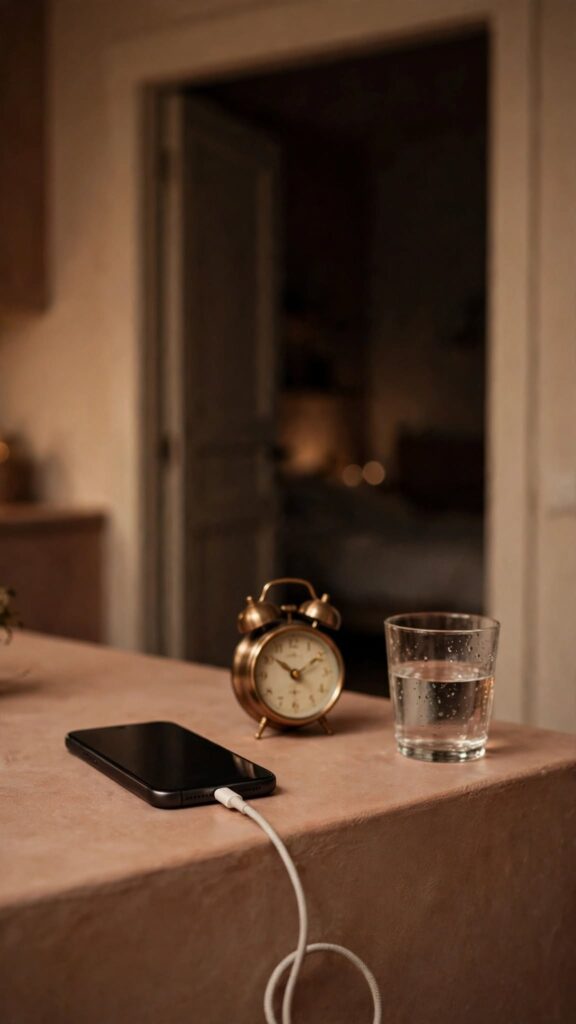
Change where the phone sleeps. This is one of the simplest and most effective steps. Charge it in another room overnight, and buy a cheap alarm clock if you need one. Many people will find that the first and last hour of the day change dramatically when the phone is not within reach.
Make the worst app harder to open. Move it off your home screen or turn the screen to grayscale. None of these is magic, but each adds a pause between the urge and the action, and a pause is often enough to remind you that you have a choice.
Decide on windows, not on rules. Instead of promising never to look, choose times when you will. Perhaps you check messages in the late morning and the late afternoon, and nowhere else. Boundaries with a clear shape are easier to keep than vague resolutions.
Prepare for the empty moment. The urge usually arrives in a gap, standing in line or waiting for the water to boil. Decide in advance what you will do instead, even if it is only looking out of the window or saying a short prayer and singing a song. An empty moment that has no plan will almost always be filled by the phone.
Tell someone! James wrote that we should confess to one another and pray for one another, so that we may be healed. I know it might feel silly to confess a problem with scrolling, but the principle is the same. Say to a friend or a spouse that you want to use your phone less, and ask them to check in with you. Secrecy and shame make any compulsion stronger.
Notice what you are avoiding. When you feel the pull, ask what you were just feeling before it came. If it is loneliness, call someone. If it is dread, take the smallest first step on the task. If it is exhaustion, rest properly. The need is usually legitimate, and it deserves a better answer than a screen.
Seek professional help if it is affecting your work or your relationships in serious ways. A counselor can help you look at the deeper patterns, and there is no shame in that.
When You Slip
You will probably slip, and that is part of the walk. One long evening on the couch does not erase the progress you have made. Solomon wrote that a righteous person may fall seven times and rise again.
16 for though the righteous fall seven times, they rise again,
Proverbs 24:16 New International Version
but the wicked stumble when calamity strikes.
The goal is not a perfect record. It is returning to the path as soon as you notice you have left it.
If you wake at two in the morning with the phone in your hand, put it down and say a short sentence, such as, Lord, I need your help with this. Then go back to sleep, or sit in the dark for a few minutes. You do not need to punish yourself. That would only make you want to escape again.
What She Did
The nurse did not throw her phone in the river, it would be funny if it did. A few days later, on her night off, she bought a small alarm clock and set the phone to charge in the kitchen. The first night was harder than she expected. She lay in the dark with her hands feeling oddly empty, and she noticed how loud her own thoughts were without anything to drown them out.
On the third night, she prayed for the first time in a long time without being interrupted. She found that she did not have a great deal to say, and that the silence was not as frightening as she feared. By the end of the week, she was falling asleep faster, and her daughter noticed that when she asked a question at dinner, her mother looked up at once.
She still slipped some evenings. But she kept the alarm clock, and the next morning she was always able to put the phone back in the kitchen.
Read Also: The-hard-questions (series tag)
Read Also: How to Review Your Year as a Christian: Looking Back Without Shame
Read Also: The Weekly Rhythm Reset: The Thirty to Ten-Minute Walk Without Your Phone
Where to Find Help
If your phone use is affecting your work or your relationships in ways that worry you, please speak to a doctor or a pastor you trust. If you are struggling with a deeper addiction that also involves your phone, such as gambling or pornography, the next entries in this series will look at those. In your country I am sure there is a National Drug Law Enforcement Agency that likely runs a toll-free drug treatment call centre that offers confidential counselling and support at any hour. Please check the agency’s official website for the current number, since numbers can change. Elsewhere, findahelpline.com lists confidential helplines by country.
If you are in immediate danger or thinking of harming yourself, contact your local emergency services right away.
Walk With Us
This series looks at one kind of addiction each Wednesday. If there is one you would like us to cover, tell us in the comments or through the contact page. You do not have to give your name.
See you next Wednesday, for another step on the walk.