


This is where we land every Saturday evening, as the week closes and the Lord’s day comes near: one quiet look at what it means to belong exclusively to God, and one small step toward it.
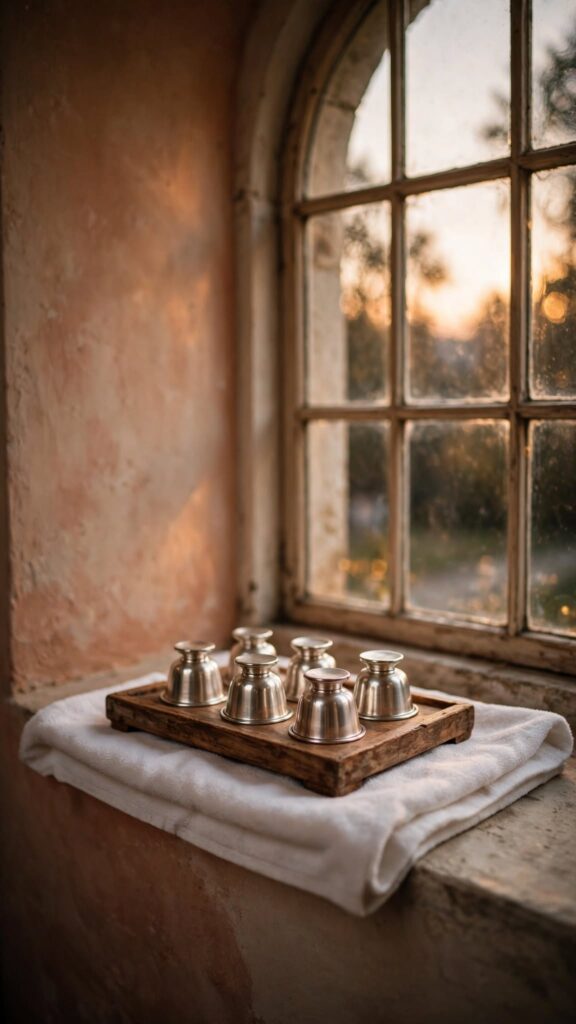
Every first Sunday, a man named Peter stays behind after the service at his church to wash the communion cups. There are about sixty of them, small and silver, kept in a wooden tray in a cupboard behind the pulpit. He fills the sink with warm water and washes each one with a cloth, then sets them upside down on a towel to dry.
One evening, his nine-year-old granddaughter came to help him. She picked up a cup and turned it over, then said that it looked like one of the cups in her kitchen at home. He told her that it was almost the same. She thought about it for a moment and asked a fair question. Then why can we not use these at home?
He opened his mouth to answer, and he found that he did not know quite how to say it. The cups were not made of anything special. They were not older than other cups, or any more valuable. What was different about them was only that they had been chosen, and then kept for one purpose. Nobody drank coffee from them, and no one put a pencil in them.
He told her that these were set apart. She nodded, as if that explained something. And then she handed him the next cup, and he realized, standing there with his hands in the water, that he had been trying to say the word consecrated.
An Old Word We Have Almost Lost
Consecration is one of those words we hear in church and rarely stop to define. It sounds serious, maybe a little distant, as if it belongs to monks and ministers.
At its heart, the word is simple. To consecrate something is to set it apart for a sacred purpose. The ordinary becomes the dedicated, not by changing what it is, but by changing what it is for.
The Hebrew word behind it carries the idea of separation and holiness, of something taken out of common use and given to God. In the Old Testament, we meet it everywhere. The priests were consecrated, set apart to serve in the tent where God met His people. The furniture and the lamps were consecrated, each one used for worship and for nothing else. Even a day was consecrated. The Sabbath was set apart from the other days of the week, kept for rest and for God.
The cups at Peter’s church are a small picture of this. What made them holy was not their material. It was a decision, and a purpose that followed.
It Is Not About Being Perfect
This is where many of us get stuck. We hear that we are called to be consecrated, and we immediately think of what we would have to become. Quiet most of the times and more disciplined. We imagine a standard we cannot meet, and we conclude that consecration is for someone else.
But look at the cups again. They did not become holy by being flawless. Trust me when I say that a few of them were dented. They were chosen anyway. The setting apart came first, and the use followed. They did not earn their place in the cupboard by being worthy of it.
Apostle Paul described this beautifully when he wrote to Timothy about the different kinds of vessels in a large house.
20 But in a great house there are not only vessels of gold and silver, but also of wood and clay, some for honor and some for dishonor. 21 Therefore if anyone cleanses himself from the latter, he will be a vessel for honor, sanctified and useful for the Master, prepared for every good work.
2 Timothy 2:20-21 New King James Version
Some were made of gold and silver, he said, and some of wood and clay. Some were for special purposes, and some for ordinary ones. And then he said that anyone who cleanses himself from what is dishonorable will be a vessel for special purposes, set apart and useful to the master, prepared for every good work. The invitation is not reserved for the polished. It is open to anyone willing to be cleaned and used.
Consecration, then, does not begin with a record of success. It begins with a yes.
From Something and For Someone
There are two sides to consecration, and both matter.
The first side is separation. To be set apart means to be taken out of something. For the cups, it meant being taken out of the kitchen. For us, it may mean stepping away from habits or loyalties that pull us in another direction. Moses told the people of Israel that they were to be holy because the Lord their God is holy.
2 “Speak to the entire assembly of Israel and say to them: ‘Be holy because I, the Lord your God, am holy.
Leviticus 19:2 New International Version
That holiness meant, in part, living differently from the nations around them.
But the second side is just as important, and it is the one we forget. We are not only set apart from something. We are set apart for Someone. The cups are not hidden away to be admired. They are kept for the table where people remember the cross. Consecration is not retreat. It is belonging.
If we focus only on what we have to give up, the life of consecration feels like a list of subtractions. But if we remember that it is for God, it becomes something warmer. A person who is consecrated is not primarily someone who says no to many things. They are someone who has said yes to one thing, and let that yes shape everything else.
What Jesus Did for Us
Before we think of consecration as something we have to produce, it helps to remember that Jesus has done something on our behalf.
On the night before His death, Jesus prayed for His followers. In that prayer, He said that for their sake He sanctified Himself, so that they too might be truly sanctified.
19 For them I sanctify myself, that they too may be truly sanctified.
John 17:19 New International Version
The word means the same thing we have been talking about, to set apart. He set Himself apart for the cross, and He did it for us.
That changes the shape of the whole matter. We do not consecrate ourselves out of an empty cupboard, trying to earn God’s attention. We respond to a God Who has already set Himself apart for us, and Who has already called us His own. Our dedication is an answer to love, and not a payment toward it.
Apostle Paul put it this way in his letter to the Romans.
A Living Sacrifice
12 Therefore, I urge you, brothers and sisters, in view of God’s mercy, to offer your bodies as a living sacrifice, holy and pleasing to God—this is your true and proper worship.
Romans 12:1 New International Version
Notice the order. First comes mercy, and then comes the offering. The same apostle Paul who describes the call also tells us what it rests on.
What Consecration Looks Like in a Week
Consecration is a choice to belong to God, and it does not always look dramatic. It looks like decisions made in small hours.
It looks like the way we start a morning, whether we give the first moments to God or to our phones. It looks like how we handle money, and who we choose to forgive. It looks like what we allow in our eyes and ears, and what we refuse. It shapes our work and our rest, and the way we speak to the people closest to us.
A consecrated life is not one without struggle.
5 Joshua told the people, “Consecrate yourselves, for tomorrow the Lord will do amazing things among you.”
Joshua 3:5 New International Version
They had a night to prepare. The word he used suggests a deliberate turning of the heart, a getting ready for God. We, too, can set aside a few quiet hours before the Lord’s day to get ready.
That is why this series arrives on Saturday evenings. It is a time when the week is closing and Sunday is near. For many of us, it is the moment when the noise starts to settle and we are able to ask, if only for a few minutes, what we are actually giving our lives to.
A Prayer of Consecration for This Week
You may like to pray this sentence slowly, perhaps tonight, perhaps again on Sunday morning.
“Lord, I am yours, and I set myself apart for you again, with all my flaws, for whatever you want to do through me.”
One Small Practice for This Week
Choose one ordinary thing in your life and set it apart for God on purpose. It might be the first ten minutes of your morning, a cup of coffee, a particular chair, or a day of the week. Decide that this thing will be used for prayer and for nothing else.
Each time you come to it, remember the cups. They were not special because of what they were made of. They were special because someone set them aside. You are not doing something impressive. You are doing something small and faithful, and that is the way consecration usually begins.
Read Also: The-hard-questions (series tag)
Read Also: The-addiction-recovery-walk (series tag)
Read Also: Worldview-clash (series tag)
Conclusion
Peter finished drying the last cup that evening and laid it in the wooden tray with the others. His granddaughter had wandered off. He stood there alone for a moment, with the water going cold in the sink, and he thought about a prayer he had said at his own baptism more than forty years earlier. He had not understood very much of it. But he had meant it.
He closed the cupboard and thought that he was a bit like one of those cups, dented in a few places, and ordinary in most ways. And yet, on a Sunday morning, he would sit in the third row, and Someone would hold out His hands, and he would be used for something far larger than himself. He turned off the light and went to find his granddaughter.
What does it mean for you to belong fully to God? Tell us in the comments, and we may feature your thoughts in a future entry.
See you next Saturday evening, for another step in a life consecrated.


