Why the Family Table Still Matters: A Christian Case for Eating Together Without the Guilt

On a Tuesday evening in March, a father set four places at the kitchen table. He had made chicken and chips, which somehow for him took the better part of two hours, and he had texted everyone at five o’clock to say dinner would be at seven. At seven, his wife sat down. His fifteen-year-old son said he would be there in a minute and did not come. His daughter, who was eleven, called down from upstairs that she was on a video call and would eat later.
He sat in front of the steaming pan for a while. Then he made a plate for his wife and one for himself, and the two of them ate in an odd, polite quiet. The two empty chairs were right there, and neither of them mentioned it. Later that night, he washed the pan and thought about his own grandfather, who had run a barbershop for forty years and still insisted on a long Sunday meal that nobody was allowed to skip.
He had always assumed that this kind of table was something his family would simply grow into. It was only on that Tuesday, standing at the sink with his hands in the water, that he understood it had not happened by itself, and that it would not.
What We Are Really Missing
Most of us feel some vague sense that eating together matters. We say it in the abstract, and we feel a bit unease when we see a family laughing around a table in a film. Then we look at our own week, full of practices and late meetings, and the unease turns into guilt.
I want to be careful here, because guilt is not the purpose of this article. If you are reading with a tight chest, thinking about how few meals your family shares, I would like you to loosen your shoulders. I am not writing to tell you that you are failing. I am writing because I think the table is worth a second look, and because it is possible to bring it back in small and realistic ways.
It helps to say clearly what a shared meal is. It is not a performance, and it does not require a homemade dinner or a candle. At its simplest, it is people in the same room, facing each other, doing something ordinary together for twenty minutes. That is all. And yet that ordinary thing seems to carry more than we expect.
Many studies over the years have found that children in families who eat together regularly often do better in several areas of life. And I must tell you that these studies mostly show a link, not a cause. Families who manage regular meals may have other advantages that matter just as much. So I would not claim that a nightly dinner will fix a child. What I will say is that everyone who has studied the subject seems to believe that the table a great place for bounding, oneness, laughter, communication, and encouragement, and this gives us something many of us are short on, which is unhurried time with the people we love.
The Table in Scripture
The Bible is full of meals, far more than most of us notice when we read it. Once you begin looking, it is almost hard to stop.
Jesus ate with people constantly. He ate with tax collectors and with respectable religious leaders. He ate at weddings and in the homes of friends, and once he fed a crowd of thousands on a hillside. The people who disliked him noticed it, too. They complained that he was always at dinner with the wrong sort of person, and he did not seem to mind the accusation. A great deal of what he taught, he taught at a table.
Think about what happened after the resurrection. Two disciples were walking home, grieving, and a stranger joined them on the road. They walked and talked for miles, and they did not recognize Him.
28 As they approached the village to which they were going, Jesus continued on as if he were going farther. 29 But they urged him strongly, “Stay with us, for it is nearly evening; the day is almost over.” So he went in to stay with them.
30 When he was at the table with them, he took bread, gave thanks, broke it and began to give it to them. 31 Then their eyes were opened and they recognized him, and he disappeared from their sight. 32 They asked each other, “Were not our hearts burning within us while he talked with us on the road and opened the Scriptures to us?”
33 They got up and returned at once to Jerusalem. There they found the Eleven and those with them, assembled together 34 and saying, “It is true! The Lord has risen and has appeared to Simon.” 35 Then the two told what had happened on the way, and how Jesus was recognized by them when he broke the bread.
Luke 24:28-35 New International Version
It was only when He sat down at their table, took the bread and broke it that they saw who He was. The recognition did not come in the sermon. It also came in the meal.
A little later, Jesus appeared to his friends on a beach, where some of them had been fishing all night. When they came ashore, He had already lit a fire and was cooking fish. Come and have breakfast, He said. The risen Lord, in that moment, was doing something very ordinary and very kind, which was making sure His tired friends were fed.
The early church grew much in the same way. The first believers broke bread together in their homes, moving from house to house, and they ate with glad and sincere hearts. We often imagine the first Christians as people who gathered mainly to hear teaching or pray, and they did both. But a great deal of their shared life happened over food, in ordinary kitchens, around ordinary tables.
Solomon wrote that a simple meal of vegetables where there is love is better than a fattened calf where there is hatred.
17 Better a small serving of vegetables with love
Proverbs 15:17 New International Version
than a fattened calf with hatred.
That line has comforted me many times. It tells us that the quality of a meal is measured by what is going on between the people who sit down to it, not by what is on the plates.
What a Table Does That a Screen Cannot
Let me describe what I think happens at a table, and why it seems hard to replace.
A table slows us down. A meal takes time, and the time has a natural edge. For twenty or thirty minutes, people are in the same place without any other task to complete. That kind of shared pause is rarer than it used to be in many homes, and it does something to the temperature of a household.
Also, a table gives people a reason to look at each other. You can learn a great deal by watching someone eat dinner. You notice the daughter who pushes food around because something at school has weighed on her. You notice the husband who is unusually quiet, or the son who laughs a little too loudly. Parents often say that the most important conversations with their children did not happen at planned moments. They came in the middle of ordinary talk, at a time nobody had scheduled.
And a table teaches without lecturing. Children learn how to listen at a meal and how to wait for a turn to speak. They learn how to tell a story. They learn that they are expected, that a place has been set for them, and that their absence would be noticed. That last lesson may be the quietest and the deepest.
There is also something spiritual in it. When Christians gather for the Lord’s Supper, we do so at a table. We are reminded that our faith is not only a set of ideas but a shared life, and that sharing food is one of the oldest ways human beings say, I belong with you. And the kitchen or dinner table is a smaller echo of that.
When the Table Is Hard
Trust me, I know I have been writing as though everyone has a big, cheerful family and a kitchen or a dinner table with room for six. Many of us do not, and I would be dishonest to skip the obstacles.
Some of you work evening shifts, and your family cannot possibly eat together at six. Some of you are raising children alone and are simply too tired to cook. Some of you live by yourselves, and the table is a table for one. Some of you have a home where the dinner hour is the worst hour of the day, because that is when the old arguments return.
Let me say a word to each of these situations without pretending there is a single answer.
If your schedule does not allow a nightly meal, choose the meal that does work. It could be breakfast on Saturday, or a late snack after the evening shift, or a Sunday lunch. A table does not have to be at dinner. What matters is that it is regular enough to be expected, and that it is yours.
If you are exhausted, lower the standard on purpose. Pizza or snacks eaten at a table together is better than a beautiful dinner eaten alone in separate rooms. The food is not the point, the togetherness is.
And if you live alone, set a place for yourself deliberately now and then. Put the phone in the other room, light a candle if you like it, and eat slowly. Invite someone once a month. A table for one can still be a place of gratitude, and a table for two can be the start of a friendship.
And if your table is tense, begin smaller. You do not need to fix the whole family in one evening. Agree on one rule, such as no arguments about anything that happened earlier that day, and see whether the quiet lets something else grow. If the tension runs deep, it may be worth talking to a pastor or a counselor, because a table cannot carry what only a longer conversation can heal.
What I Would Try First
My dearest readers, if you want to begin, I would start with one meal a week and treat it as a promise.
Choose the meal that is least likely to be disrupted. Put it on the calendar the way you would a doctor’s appointment, and tell everyone in the house that it is not optional. Say it kindly, but say it! People rarely resent a standing meal for long, even when they groan at first.
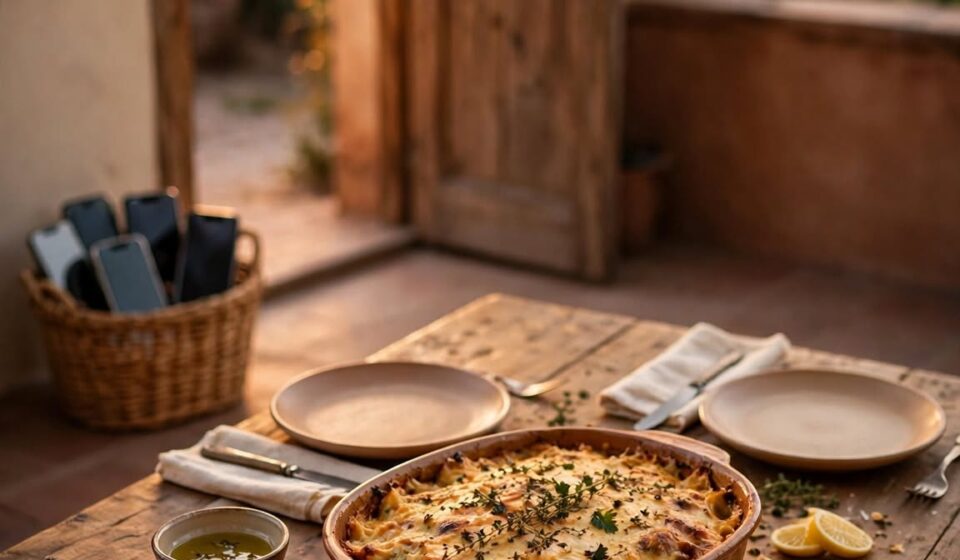
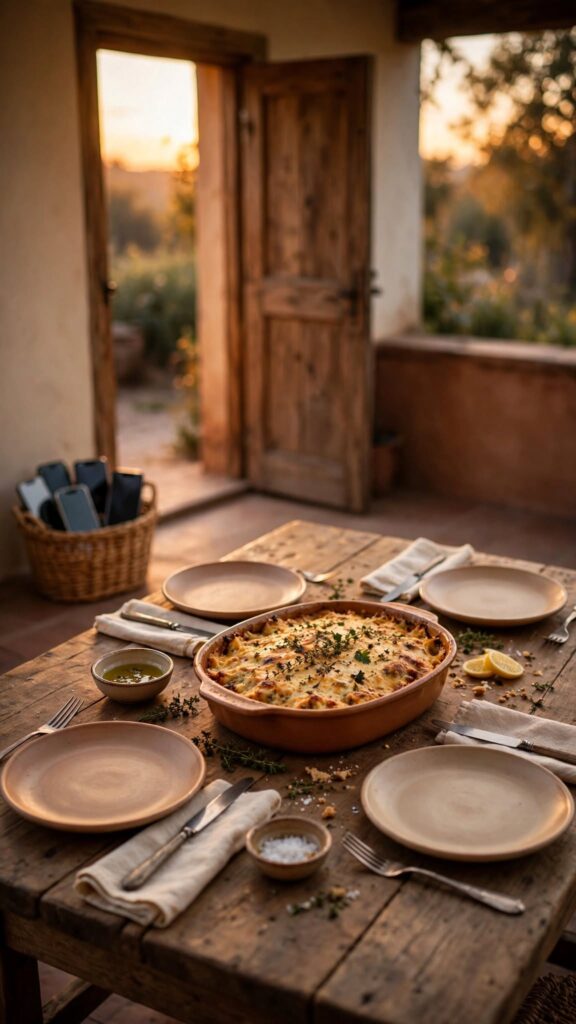
Take the phones away from the table, and that includes yours. Keep them in another room or in a basket if you can. It is a simple rule that carries more weight than any other, because a phone on the table says that the people who are not here matter more than the people who are.
Ask one good question. The usual one, how was your day, almost always receives the word fine. Try something with more room in it. “What was the best part of today?” “What was something that made you laugh?” “What was something that did not go the way you hoped?” Then listen to the answers without correcting them, which may be the hardest part.
Let everyone take part. Children can set the table or choose the music. Teenagers can pick a recipe once a month. When people have helped to build the meal, they usually show up for it.
Say a short prayer of thanks, let it be a part of your home. Many families will find that a simple prayer, said by a different person each night, becomes the part children remember longest. If prayer at the table is new for you, it is fine to begin with a single sentence of gratitude.
And finally, be patient. It may take weeks before the table feels natural, and some evenings might fall flat. A teenager might say very little for a month. That does not mean it is failing. Think of it as laying down a rhythm. The conversation you wanted may arrive on a night when you least expect it, because you were there, and so were they.
The Part We Do Not Control
I should add one more honest thing. You can build a lovely table and still have a child who drifts away from it. You can set a place for someone who never sits in it. That happens in good homes, and it is not always a sign of anything you did wrong.
What the table offers is not a guarantee. It offers a standing invitation. Years from now, a grown child may not remember much of what was said, but they may remember that a place was always set for them. That memory can be a kind of home that a person carries long after the house has changed.
Jesus told a story about a father whose younger son left home and spent everything he had. The father did not forget him. He kept watching the road, and when the son finally came back, he ran to meet him and called for a feast.
20 So he got up and went to his father.
“But while he was still a long way off, his father saw him and was filled with compassion for him; he ran to his son, threw his arms around him and kissed him.
21 “The son said to him, ‘Father, I have sinned against heaven and against you. I am no longer worthy to be called your son.’
22 “But the father said to his servants, ‘Quick! Bring the best robe and put it on him. Put a ring on his finger and sandals on his feet. 23 Bring the fattened calf and kill it. Let’s have a feast and celebrate. 24 For this son of mine was dead and is alive again; he was lost and is found.’ So they began to celebrate.
Luke 15:20-24 New International Version
The robe and the ring came out within the first hour of the homecoming. A table was waiting before the apology was finished.
That story reminds me what a table is ultimately for. It is where people are welcomed, whether they arrive on time or late, tidy or broken, ready or not.
Read Also: A-seat-at-the-table (series tag)
Read Also: When Your Child Rejects the Faith You Raised Them In
Read Also: The Friday Wind-Down: Settle One Small Grievance Before the Weekend
Conclusion
The father who stood at the sink that Tuesday did not give a speech the next day. He simply picked a Thursday, announced that dinner would be at six thirty, and ordered a pizza. He asked his son and daughter to leave their phones in a basket by the door. His son rolled his eyes and his daughter asked how long it would take.
They sat down, the four of them, with the box open in the middle of the table. For the first few minutes, nobody said much. Then his daughter mentioned, almost by accident, that a girl at school had been unkind to her that week. His son, without looking up, said that he knew the girl and that she was like that with everyone. His wife glanced at the father across the table, and he understood that none of this would have come out in a text.
He did not make a speech about it. He passed the pizza, and he asked her what she wanted to do about it. The meal ran forty minutes, which was long enough that the cheese went cold. Nobody minded. When they were done, his son carried the plates to the sink without being asked, and the father stayed in his chair a moment longer, looking at the four places that were, for once, all in use.